A full room is not a working business
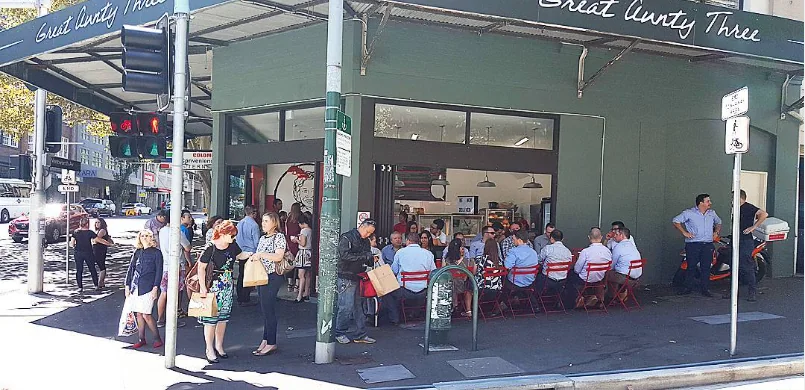
There is a photo of my second shop that I still look at.
A corner in Surry Hills. Green paint, red chairs, every seat taken. People standing on the footpath with their bags, waiting for a table. Somebody took it on their phone.
If you saw that photo, you would think I had made it.
I opened that shop in 2014 and put every dollar I had saved into it. The response was overwhelming. Some mornings the line wrapped around the corner. People stood outside and waited to eat our food.
That is the picture in your head right now if you are dreaming about opening your own place. I had it. It was real.
It was also the stretch where my health started to go, and not one person in that photo could tell.
What the photo does not show
Here is the thing nobody says out loud.
Most people think growth makes life easier. More customers, more money, more help. It does not work like that. A full room does not fix a shaky back end. It exposes it. Every crack you were getting away with on a quiet day turns into a hole on a busy one.
This is not only my story, and the numbers say so. Australian operators surveyed for the 2025 Industry Benchmarking Report, published in March 2026 by the Restaurant & Catering Industry Association of Australia, put wages at 40.25% of turnover and food at 38%. Those two lines alone average about 78% of every dollar through the till, before rent, power or insurance. In the same report, 38.4% of venues made a net profit of 2% or less, and 19.2% made a loss outright.
A full room does not change those ratios. It multiplies them. That is the whole trap in one sentence.
I was standing in that shop, in that photo, running on empty.
There are levels, and each one asks for a different version of you
I was good in the kitchen. Really good. That is the skill that got me the line out the door.
But the skill that fills a room is not the skill that runs two of them.
That is the part I did not understand. Every stage of the business asks for someone slightly different at the wheel. There are three jobs, and most operators only get taught the first one.
- The cook. You make the thing people want. This is the skill that fills the room.
- The operator. You run the floor, the roster, the margin. This is the skill that keeps the room profitable.
- The owner. You build something that keeps working on the days you are not in the building. This is the skill that lets you leave.
Nobody tells you that you have been promoted. You just start failing at a job you were never trained for, and you assume the problem is you.
So I kept doing the job I was already good at, because I was good at it. Meanwhile the job I actually needed to do, building a team structure and systems that could carry the growth, sat there untouched.
I was the bottleneck
Every decision came through me. The orders. The roster. The suppliers. The fix when something broke. The answer to every question anyone had. All of it, me.
My team wanted to take the load off. They could not. I had never built a way to hand anything over. Nothing was written down. There was no structure for someone else to step into. I had hired hands, but I had not built a business.
So the load had nowhere to go but back onto me. I was the bottleneck, and I had built it myself.
What that cost
I showed up anyway. Every day. The business needed me, and I told myself that is what a good operator does.
I was wrong.
I got exhausted, in my head and in my body. My health paid the bill. The worst part was that nobody could support me, because everything ran through the one person who was falling apart.
You cannot fix the business while the operator is falling apart. I did not read that anywhere. I lived it, standing behind my own counter, too tired to see it.
Looking back, it is the best thing that ever happened to me
I would not have said that then. I say it now, and I mean it.
That shop taught me the lesson I build everything on. Systems first. Then people. Then growth. In that order, every time.
A line out the door is not proof you are winning. It is proof that people want what you make. That is a wonderful thing and it is only the first thing. What you do with it is a separate job, and nobody hands you the manual.
If your venue cannot run without you, opening another one will not fix that. It doubles it.
If you are in that photo right now
Some of you reading this are standing exactly where I was standing.
Full room. Good reviews. Phone going all day. And underneath it, quietly, you are cooked. You cannot take a day off. You are the only one who knows how anything really works. You keep telling yourself it will settle down after the busy season.
It will not settle down. It will get busier. Busier is not the same as better.
So hear this from someone who has been there and paid for it. Being at your limit is not proof that you are weak, or that you are not cut out for this. It is proof that you have outgrown the way your business is currently built.
Those are two very different problems. Only one of them is your fault, and it is not the one you have been beating yourself up about.
I can see it now in someone else's venue, usually before they can. Not because I am clever. Because I have stood exactly where they are standing, on a corner, with a line out the door, wondering why it felt so bad when it looked so good.
Questions operators ask me about this
Why is my restaurant busy but not profitable?
Because busy is a revenue number and profit is a cost ratio, and more covers multiply the ratio instead of fixing it. In the 2025 Industry Benchmarking Report, wages ran at 40.25% of turnover and food at 38%, which is about 78% before rent, power or insurance. If your prices and your rosters are set wrong, a bigger week makes the hole bigger. The longer answer is in the guide on why a restaurant is busy but not profitable.
How do I know if I am the bottleneck in my own business?
Try to take seven days off without your phone. If the thought alone makes your chest tight, you are the bottleneck. The practical test is simpler: pick any decision made yesterday and ask whether it could have been made correctly without you. If the honest answer is no, the business runs on your memory rather than on a system, and your memory does not scale.
Should I open a second venue?
Not until the first one runs without you for a full month. A second venue does not spread the load, it doubles the number of places that need you at once. I opened mine in 2014 with every dollar I had saved and the queue proved the demand was real, but the demand was never the problem. If you cannot step away from venue one, venue two will take what is left.
What do I fix first, systems or staff?
Systems, then people, then growth, in that order. Hiring into a business with nothing written down just adds people who also have to ask you. Write down how the shift opens, how the order gets placed, how the roster gets built, and what good looks like. Then hire someone to own it. The guide on how to make a restaurant run without you walks through the order.
Will I go back?
I get asked this a lot. Will you open another one.
Of course I am.
But do not let me tell you. Let me show you.
Watch this space.
If the part about not being able to step away landed, the practical version is here: how to make a restaurant run without you. The rest of the story is in the seven chapters, and the venue itself is here.