 Notes from the rebuild · 28
You cannot read the label from inside the jar
I walked into a client's kitchen a few weeks ago, mid service, and the first thing I saw was not the food. It was the owner. Flustered. Moving twice as fast as he needed to. A new stream of customers had found the place, which is the thing every owner prays for, and it was drowning him. He was on the pass, on the pans, on the till, and he was going to be totally beat by the end of the night and back at 6am to do it again.
He had run that room for years. He is good. He works harder than anyone in the building. And he could not see what I saw in the first ten minutes, because I was standing outside the jar and he was living inside it.
I know, because for ten years I was him.
The recipe nobody questioned
Most of the owners I work with cooked a recipe they were taught. A parent, a grandmother, a chef they worked under. They cooked it the way they were shown, and it worked, and the room filled, and so nobody ever had to ask whether it could be better. So nobody asked.
By the time someone offers feedback, fifteen years in, it does not land as help. It lands as an insult to the person who taught them. That is why they are not ready for it. To them feedback is not information. It is a verdict on the whole life.
I get it. Great Aunty Three ran on my grandmother's recipes with her name over the door. If someone had walked in and told me the pho could be better I would have smiled and shown them out. But feedback is the only thing that lets you learn, grow and evolve, and the owners who refuse it do not stay the same. They slowly fall behind a market that never stops asking.
Why does busy not mean successful?
Busy does not mean successful. Busy means more work, more prep, more planning, more of you. A queue out the door is not a result. It is a load. Labour and cost of goods together can take more than 75% of turnover for Australian venues, according to the Restaurant & Catering Industry Association's 2025 Industry Benchmarking Report, and a full room does not change that ratio. It multiplies it. Unless you planned for growth before it arrived, growth is the thing that breaks you.
That owner in the flustered kitchen had a vision. He wanted the place to grow, and now it was. But he did not have the foresight to take a chance on his own vision and hire the staff to handle it. So he took the work on himself. Every extra table went onto his own back, and he called that being careful with money. It is not careful. It is the most expensive decision in the building, because the thing wearing out is the only thing the business cannot replace.
I wrote about the full room at my second shop in Surry Hills, and the line out the door that nobody saw the cost of. Same jar. Different label.
What does planning actually look like in a kitchen?
Planning is not a spreadsheet. Planning is setting the tasks so the kitchen flows. Who preps what, by when. What is done before doors so that the first order of the night is not the first time anyone has touched a pan. What gets fired in what order so that a table of six does not wait twenty minutes while a table of two gets fed twice.
Do that and three things happen at once. Patrons do not wait too long. The food comes out the same on Tuesday as it does on Saturday. And the owner gets to lift his head up from the pans long enough to see the room. Efficiency, consistency, and a good first impression, from one hour of planning that most owners think they are too busy to do.
They are not too busy. They are too inside.
The part that gets me
Here is the thing I do not say out loud in their kitchens. I see them getting older.
Not dramatically. Grey coming in at the temples between one visit and the next. The same joke about the holiday they will take "one day." A kid's birthday they were going to make it to and did not. A body that used to shrug off a double and now needs the weekend to recover, except there is no weekend. They are pouring themselves into the room a little at a time, and the room does not notice, and the room does not care. The room will take all of it if they let it.
I know what that looks like from the inside because I lived it. Four hours of sleep. Meals eaten standing up. A marriage carrying weight it was never built for. I did not see any of it as a problem. I saw it as the job. I only got out because the jar broke, and it took a divorce and a decade of savings with it.
So when I sit across from an owner who is fine, who is busy, who will get to it after Christmas, I am not looking at a client. I am looking at myself at forty, and I am trying to get him out without the crash.
What it looks like when someone lets you in
It is never a big moment. It is one shift. An owner agrees to write the prep list the night before instead of carrying it in his head. Or he hires the second cook he has been putting off for a year and discovers the food got better, not worse, because he finally had time to taste it. Or he takes one Sunday off and the place is still standing on Monday, which is the day he realises the business could run without him if he built it to.
That is the whole job. Not fixing the restaurant. Getting the owner far enough outside it that he can finally read his own label. Everything after that, he does himself.
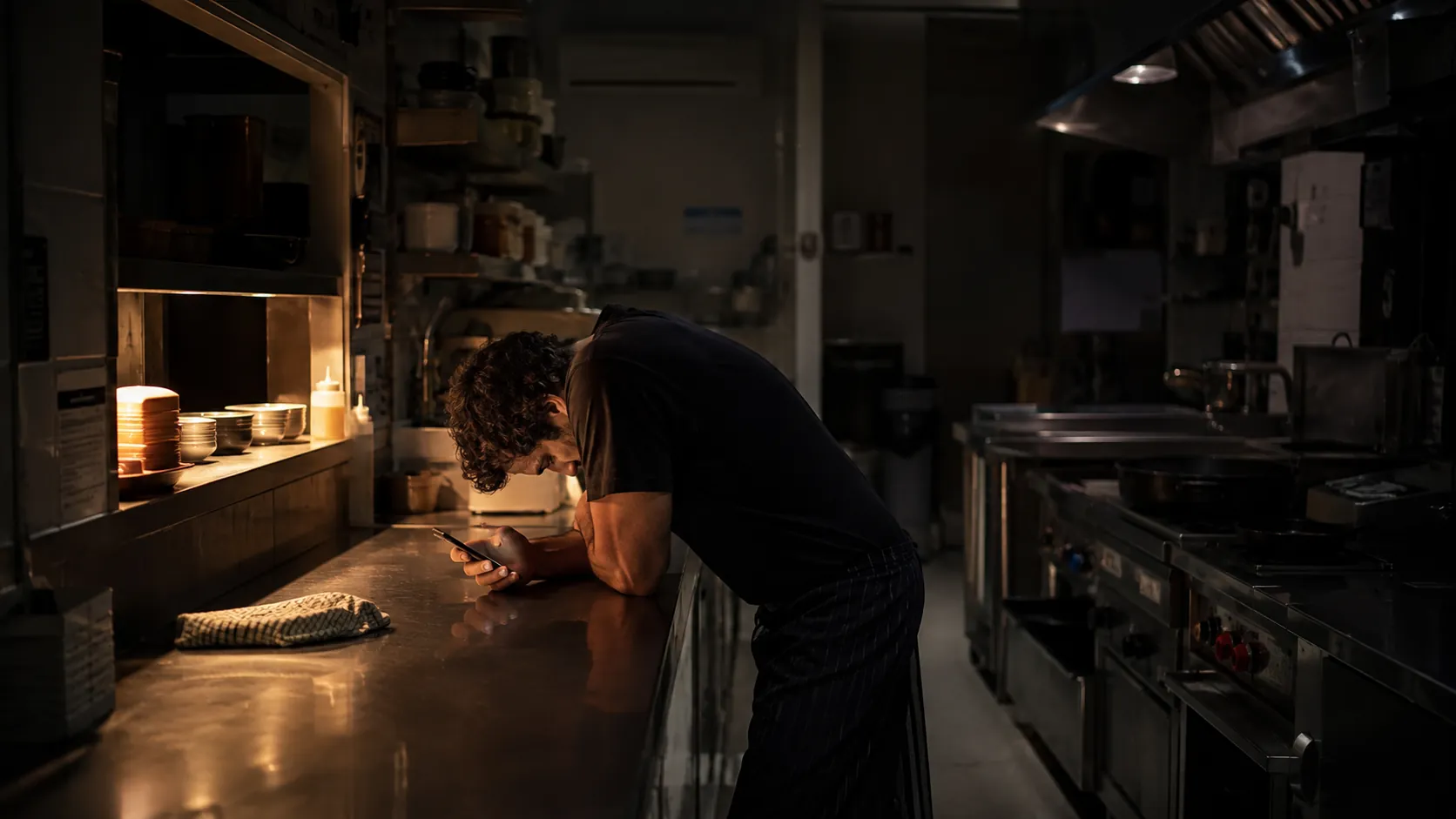
If you are reading this at 11pm after service, on your phone, in a kitchen that is finally quiet, you are the one I am writing about. You are not doing anything wrong. You are doing everything, and that is the problem. Let someone stand outside the jar for an hour and tell you what it says.
Why I walked away from a business that worked is in Unemployable. The guide version of this, with the actual steps, is How to Make a Restaurant Run Without You, and the numbers behind the full room are in Why Is My Restaurant Busy but Not Profitable. And if you want thirty minutes with someone standing outside your jar, that is a conversation I have with owners now.